

But it's not.
There are actually several quite different types of self-watering pots, and they don't all work the same way. Some use wicks, some use mineral media like LECA or Pon, some have hidden reservoirs, some have indicators at the top, some have a small window, and some make the entire bottom transparent so you can see the water directly. The basic principle is the same: water is stored below the root zone and moves up as the medium dries. But the design around it significantly changes how easy the pot is to live with, how easy it is to read, and how high the risk of hidden problems is.
This is also why two self-watering pots can look somewhat similar from the outside but feel completely different in everyday use. A good self-watering pot isn't just about having a reservoir at the bottom. It's about how the water is managed, how the roots get air, how you can read the system, and how easy it is to detect problems before the plant starts to look sad.
1. Wick-based self-watering pots
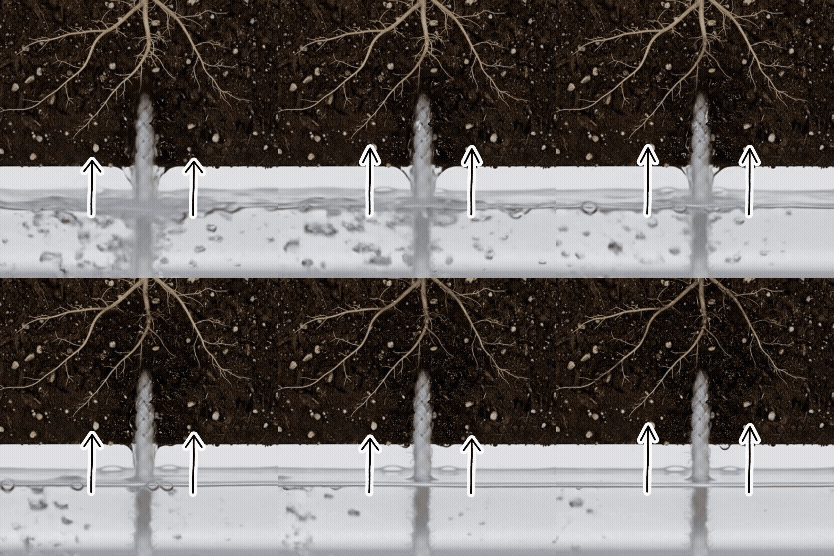
Wick systems move water up through one or more cords, strips, or wicks connecting the reservoir to the soil or medium above. This type of system is especially common in smaller pots and more modular solutions where the plant sits in an insert above a water chamber. They can work very well for small to medium-sized plants, especially when the setup is simple and easy to reconfigure. However, they are also more sensitive to whether the soil can effectively transport moisture and whether the wick material itself remains stable over time.
Here, the material matters more than many realize. Natural fibers like cotton absorb moisture quickly and dry slower, and they are more vulnerable to mold and degradation in humid environments. Synthetic fibers like polyester and nylon absorb much less moisture, and plant wicks are often sold specifically in polyester. It is therefore fair to say that polyester is usually the safer and more durable choice, while cotton is less suitable if you want a long-lasting solution.
For us, the conclusion is quite simple: wick systems can be fine, but if the wick material itself is wrong, or if the soil is too coarse or too dense, the entire system quickly becomes less stable. This is one reason why premium isn't just about "does it have a wick or not," but about how well thought out the entire setup is.
2. Classic self-watering pots with hidden reservoir
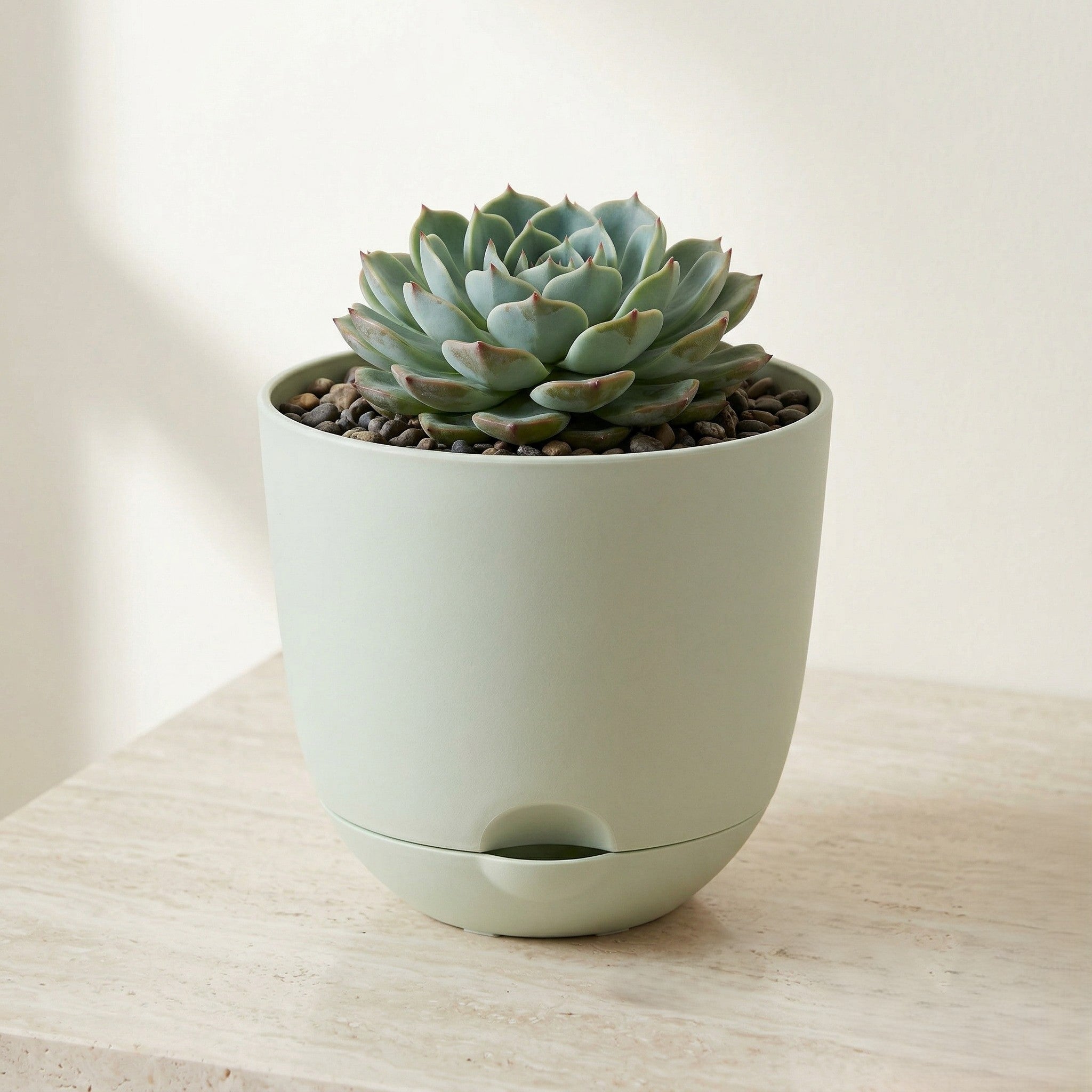
This type is probably what most people think of first. An inner pot or plant section sits above a hidden reservoir, and water is filled from below or through a filling channel. The advantage is that it looks neat and tidy, and you avoid loose trays and improvised solutions. When the system is well-made, it can make watering more stable and everyday life easier.
The downside is that hidden systems can also hide problems. If the insert cannot be lifted or if you don't have a good way to check the water level and root environment, stagnant water, hidden dirt, and nascent root problems are harder to detect. Several guides also point out that in some designs, roots can grow into the reservoir, where air and drainage become poor if the system is not properly thought out.
This is precisely where many cheaper self-watering pots fall short. They have a reservoir, yes. But they don't make it easy to see what's actually going on. And then "easy plant care" quickly turns into "I hope it's still working down there."
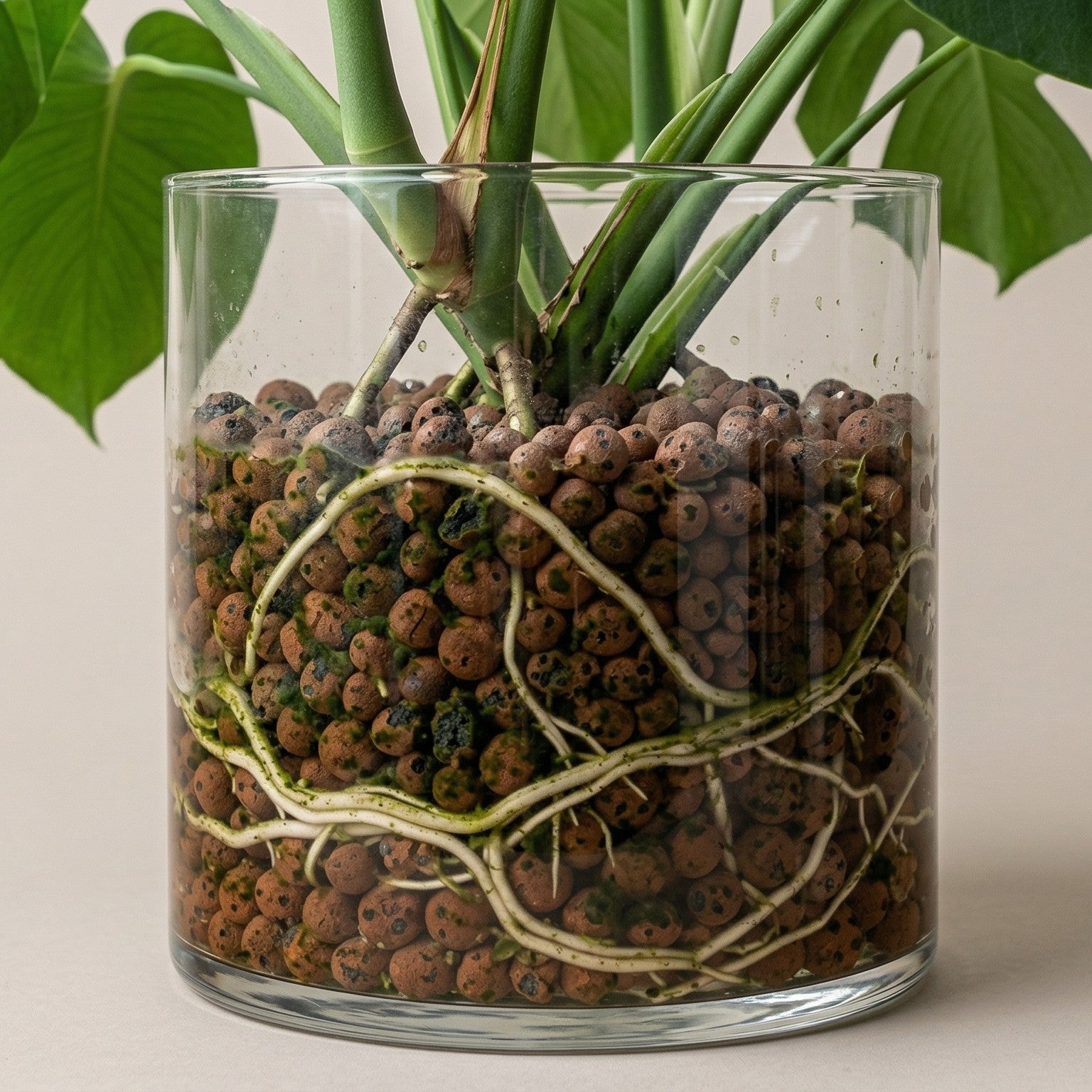
3. Semi-hydro and mineral media
This type is probably what most people think of first. An inner pot or plant section sits above a hidden reservoir, and water is filled from below or through a filling channel. The advantage is that it looks neat and tidy, and you avoid loose trays and improvised solutions. When the system is well-made, it can make watering more stable and everyday life easier.
The downside is that hidden systems can also hide problems. If the insert cannot be lifted or if you don't have a good way to check the water level and root environment, stagnant water, hidden dirt, and nascent root problems are harder to detect. Several guides also point out that in some designs, roots can grow into the reservoir, where air and drainage become poor if the system is not properly thought out.
This is precisely where many cheaper self-watering pots fall short. They have a reservoir, yes. But they don't make it easy to see what's actually going on. And then "easy plant care" quickly turns into "I hope it's still working down there."
4. Pots with an indicator at the top
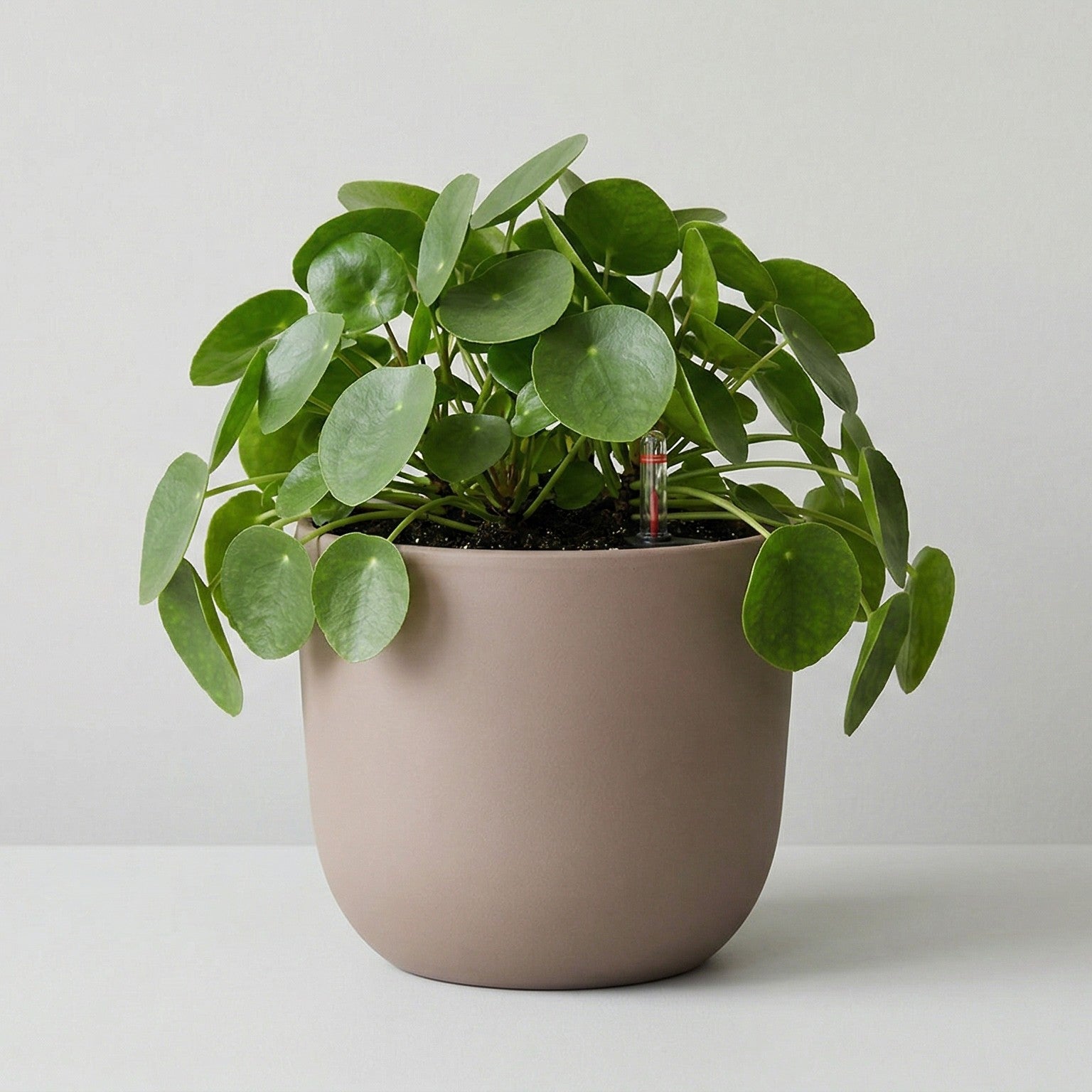
Many self-watering pots try to solve the uncertainty with an indicator at the top. This makes sense. It's clearly better than not being able to see anything at all, and both Lechuza and Elho describe their systems as solutions where an indicator or water gauge tells you when to refill. Some systems also combine the indicator with overflow, a filling tube, and a definite dry phase between refills.
However, a water indicator is still just a water indicator. It tells you how much water is in the reservoir. It doesn't tell you if the soil is wicking well, if the roots are healthy, or if the system has become too heavy and air-deprived. This is an important distinction, as many people tend to rely too much on the gauge itself.
And then there's the practical aspect: when the indicator is at the top, you typically have to go to the pot and look down at it. It's better than nothing, but it's not necessarily the most natural solution in everyday life. For us, this is one reason why a side-mounted reading makes more sense as a premium choice. You see it where you actually see the pot in your daily life.
5. Pots with a small window for water level
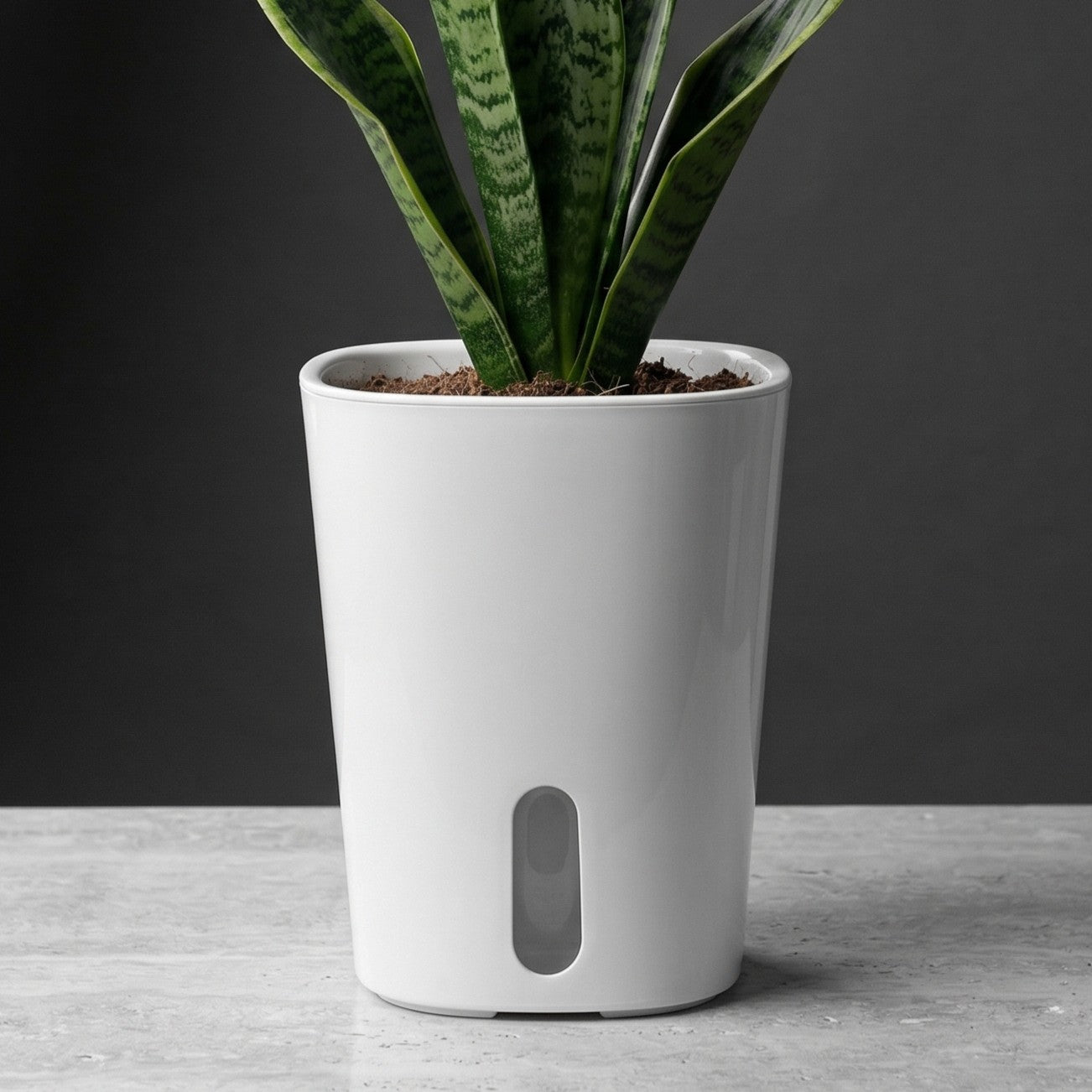
Another solution is pots with a small window where you can glimpse the water level. This can be clever because you get visual feedback without the entire reservoir being visible. However, this type of solution also involves a compromise: you only see a small part of the system, and light still gets in to a wet surface. When light hits wet, nutrient-rich surfaces, the risk of algae and biofilm increases. In practice, a thin green film is often mostly cosmetic, but over time it can make the system unsightly and more difficult to keep clean.
In other words, it's a middle ground. Better than a completely hidden reservoir, but not necessarily the solution that is easiest to live with visually or practically over time.
6. Pots with a completely transparent bottom reservoir
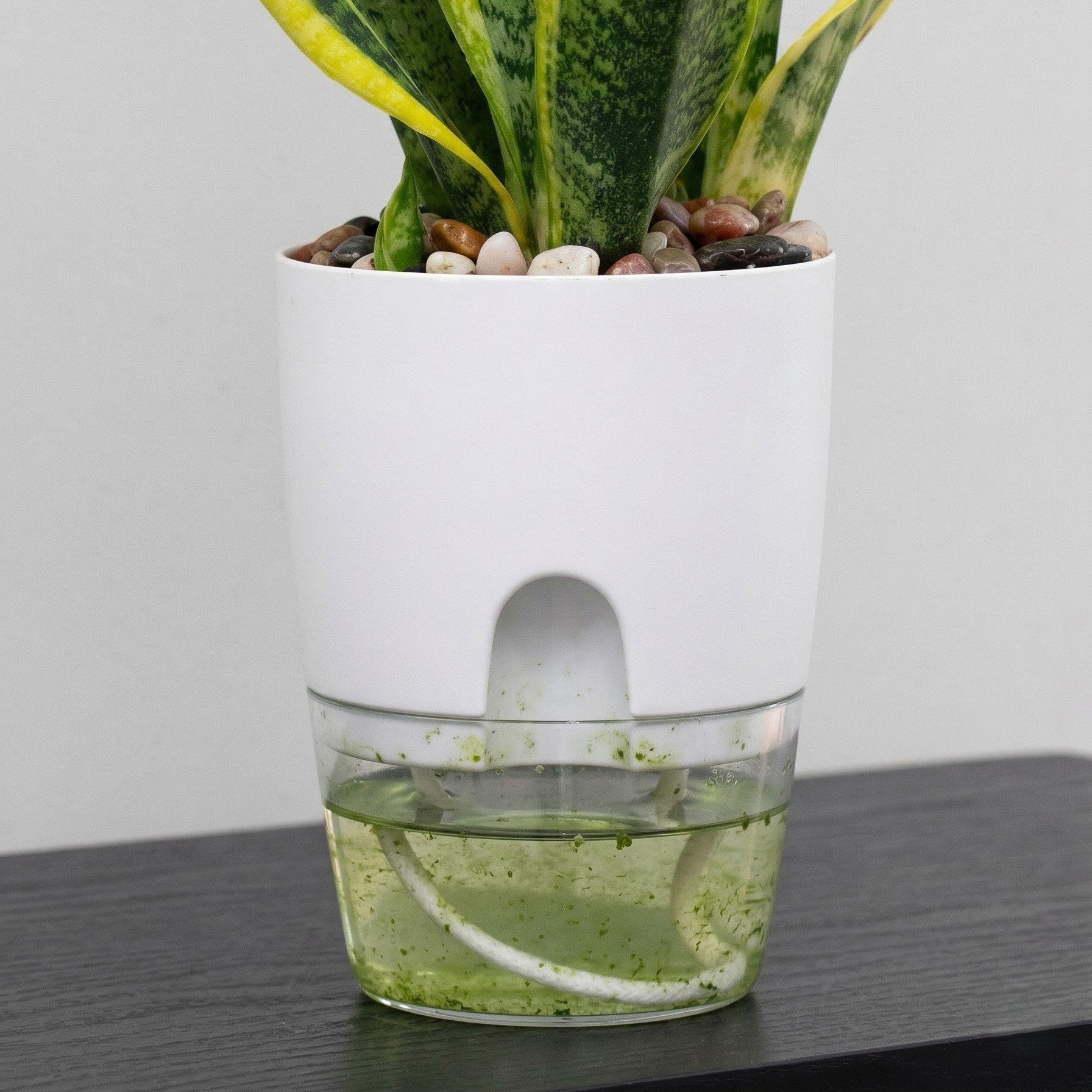
Some self-watering pots make the entire bottom or a large part of the water chamber transparent. The big advantage is obvious: you can see the water immediately. No guessing, no gauge, no hidden levels. But the big disadvantage is just as obvious: when light is allowed to hit wet surfaces again and again, algae almost become an invitation. Several plant guides describe clear pots as being more susceptible to algae growth, and in semi-hydro environments, it is mentioned again and again as a constant irritation in transparent setups.
Therefore, a transparent reservoir is somewhat the classic solution that looks smart for the first month and less premium later on. You gain visibility but often lose out on aesthetics and how clean the system feels in the long run.
So what makes a self-watering pot Premium?
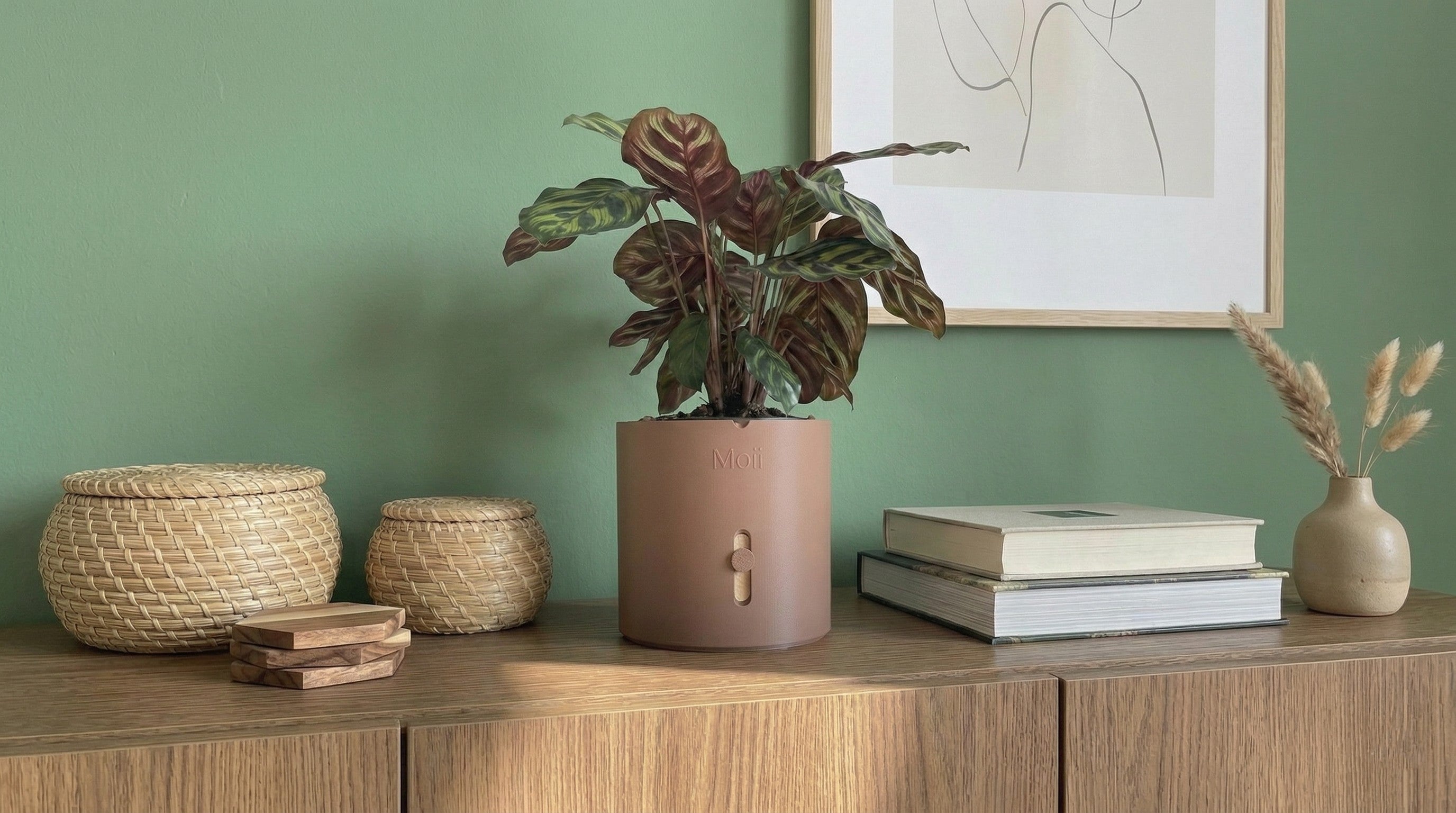
For us, a premium self-watering pot isn't just about the plant being able to get water from below.
It's about the entire experience being well thought out.
- You should be able to see when to refill without the pot becoming technical, messy, or unsightly.
- Roots need both moisture and air, not just a hidden water chamber.
- The system must work with good, airy soil and not require ordinary plant owners to suddenly learn semi-hydroponics and nutrient solutions.
- Wicks and materials must be made to last, not just to work initially.
- The reservoir must be easy to use but not invite unnecessary light to water and algae.
This is also why we believe Moii performs better in the premium segment than most other types. Not because other self-watering pots are inherently bad, but because many of them solve one problem and create a new one. Either you can't see the water level. Or you can see it, but only from above. Or you can see it all the time, but through a transparent bottom that quickly becomes less appealing to look at.
Moii attempts to solve this in a more holistic way. You get soil-based self-watering, which is easier to understand and use in a normal home. You get a solution where everyday visibility is integrated as a real part of the product. And you get a system that makes more sense with airy soil, so the roots don't end up in a heavy, stagnant bottom.

